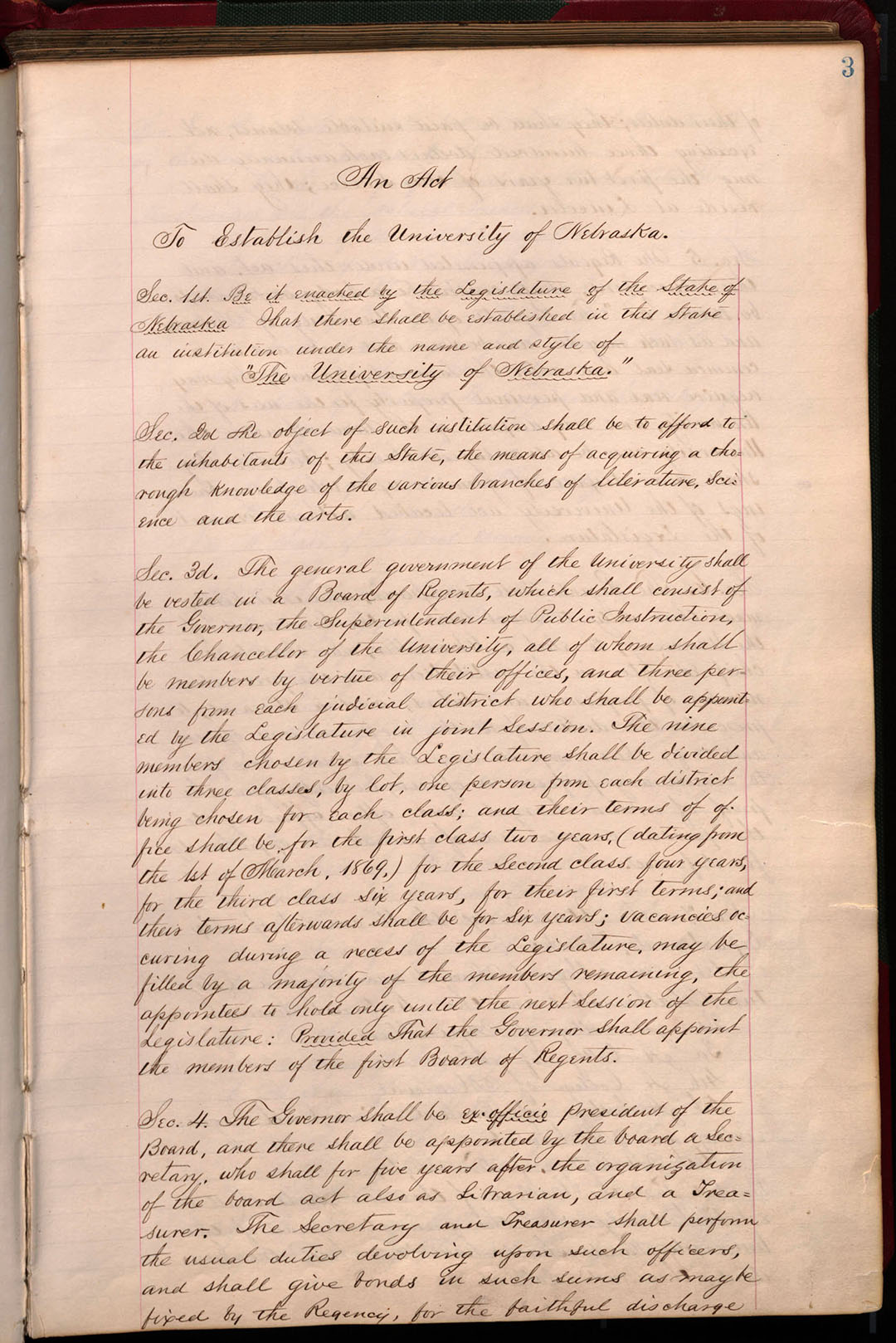
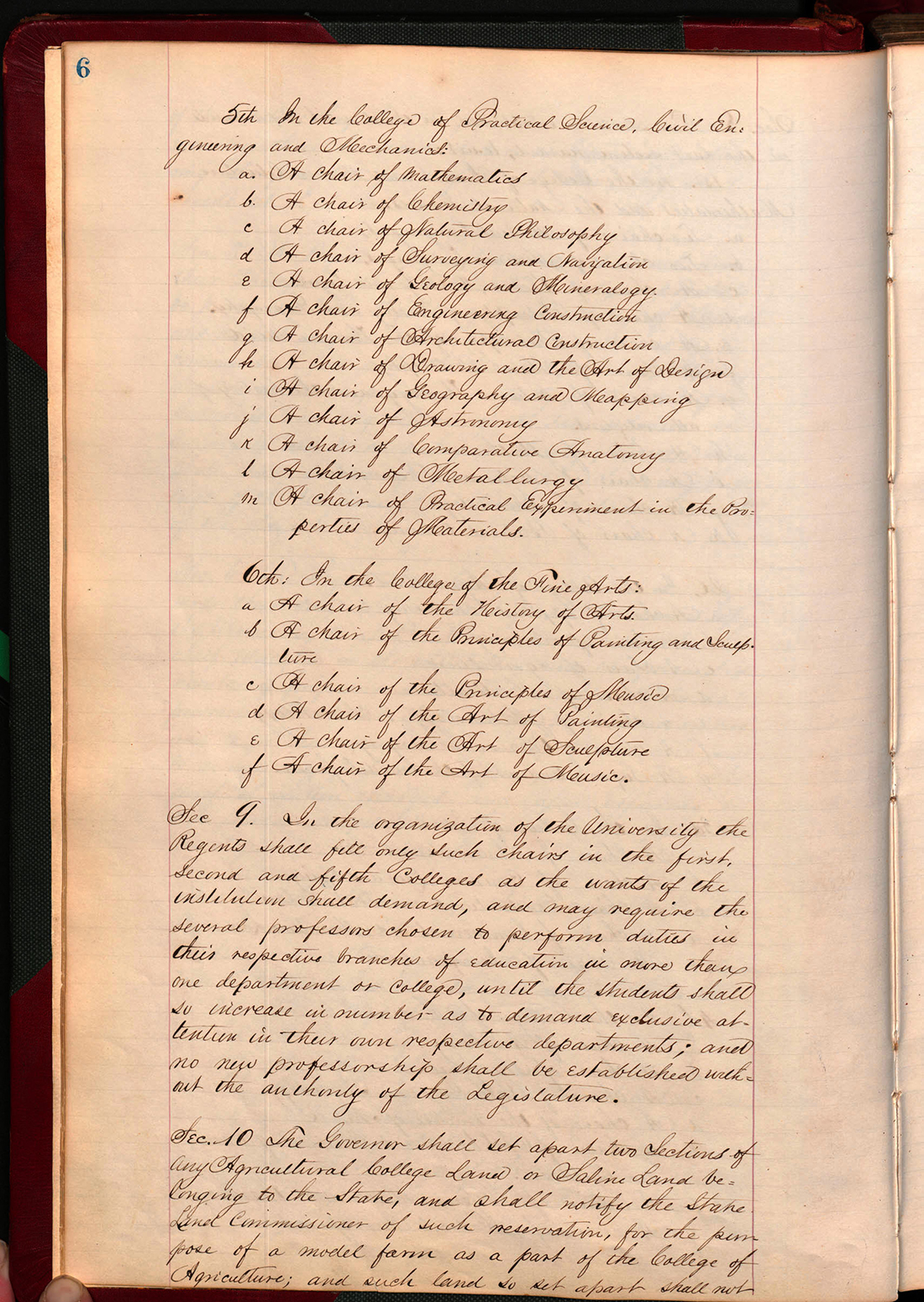
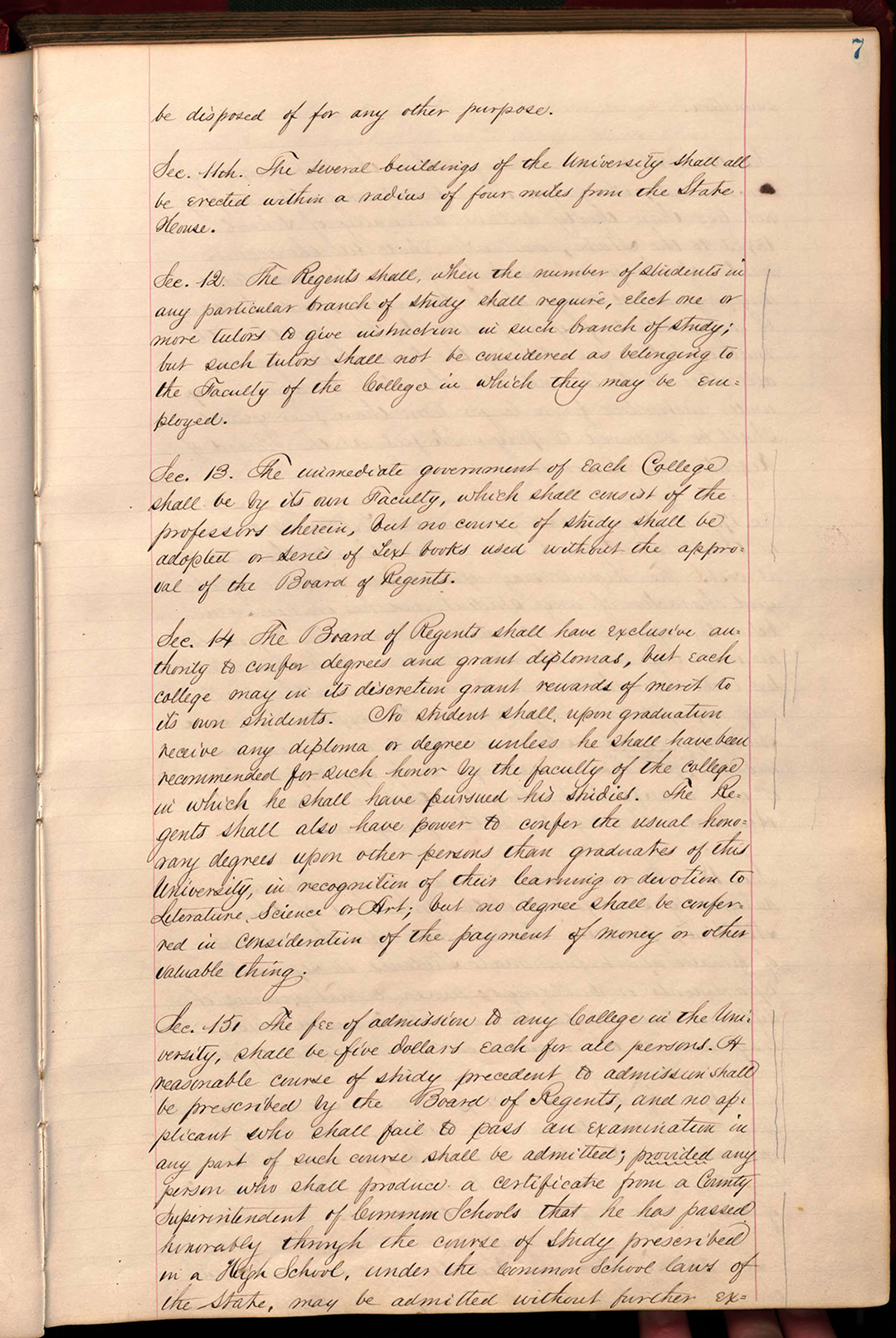
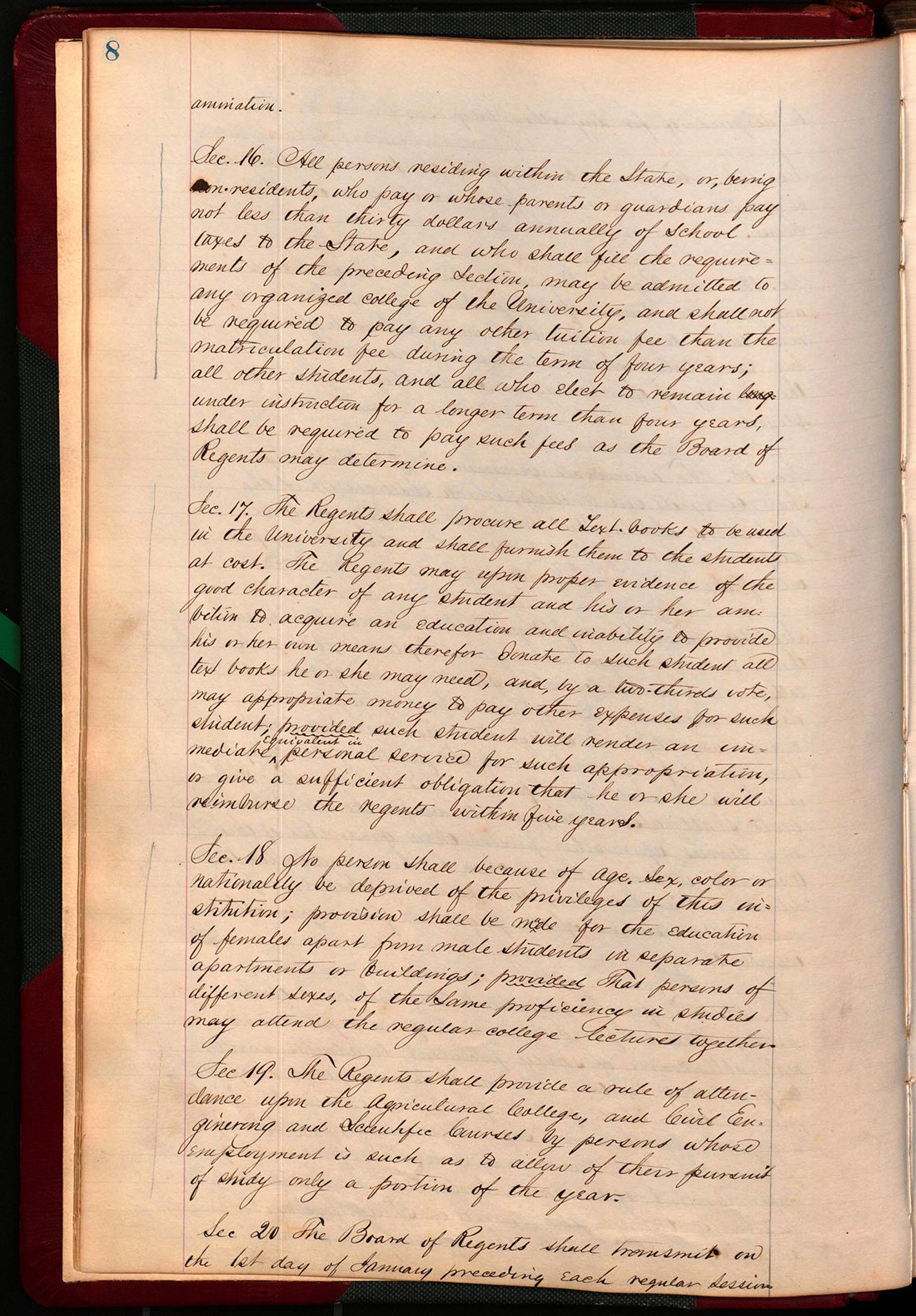
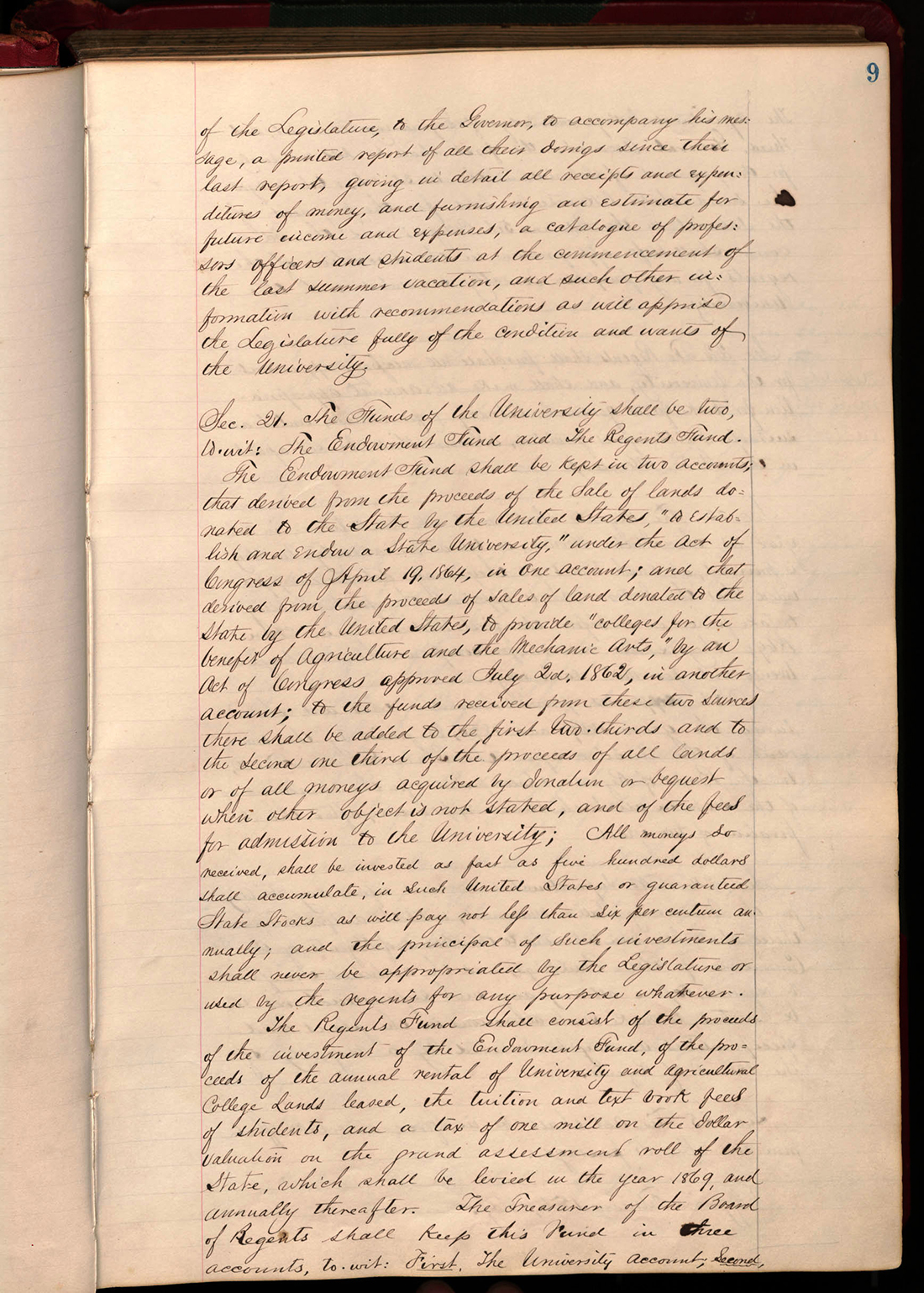
Editor's Note: Approved Feb. 15, 1869, this act of the Nebraska Legislature formally established the University of Nebraska. The complete text of the original charter appears below. Scanned images of the act's eight pages are at right. The document is also available for review in the University Archives and Special Collections.
An Act to Establish the University of Nebraska.
Section 1
Be it enacted by the Legislature of the State of Nebraska that there shall be established in this state an institution under the name and style of “The University of Nebraska.”
Section 2
The object of such institution shall be to afford to the inhabitants of the state, the means of acquiring a thorough knowledge of the various branches of literature, science and the arts.
Section 3
The general government of the university shall be vested in the Board of Regents, which shall consist of the governor, the superintendent of public instruction, the chancellor of the university, all of whom shall be members by virtue of their offices, and three persons from each judicial district who shall be appointed by the Legislature in joint session. The nine members chosen by the Legislature shall be divided into three classes, by lot, one person from each district being chosen for each class; and their terms of office shall be for the first class two years, (dating from the 1st of March, 1869,) for the second class four years, for the third class six years, for their first terms; and their terms afterwards shall be for six years; vacancies occurring during a recess of the Legislature may be filled by a majority of the members remaining, the appointees to hold only until the next session of the Legislature: Provided that the governor shall appoint the members of the first Board of Regents.
Section 4
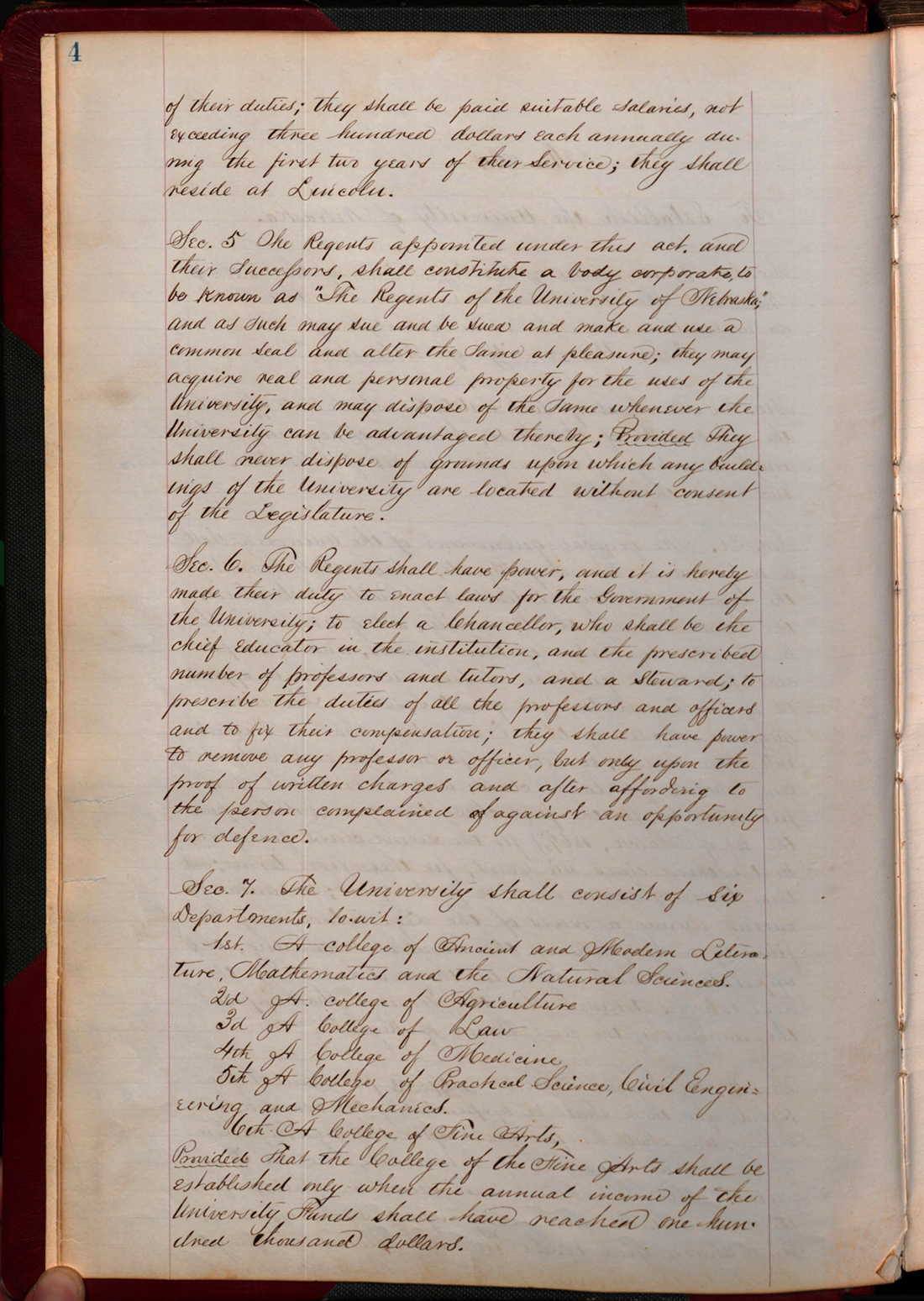
The governor shall be ex officio president of the board, and there shall be appointed by the board a secretary, who shall for five years after the organization of the board act also as librarian, and a treasurer. The secretary and treasurer shall performing the usual duties devolving upon such officers, and shall give bonds in such sums as may be fixed by the regency, for the faithful discharge of their duties; they shall be paid suitable salaries, not exceeding three hundred dollars each annually during the first two years of their service; they shall reside at Lincoln.
Section 5
The regents appointed under this act, and their successors, shall constitute a body corporate to be known as “The Regents of the University of Nebraska;” and as such may sue and be sued and make and use a common seal and after the same at pleasure; they may acquire real and personal property for the uses of the university, and may dispose of the same whenever the university can be advantaged thereby; provided they shall never dispose of grounds upon which any buildings of the university are located without consent of the legislature.
Section 6
The Regents shall have power, and it is hereby made their duty to enact laws for the government of the university; to elect a chancellor, who shall be the chief educator in the institution, and the prescribed number of professors and tutors, and a steward; to prescribe the duties of all the professors and officers and to fix their compensation; they shall have power to remove any professor or officer, but only upon the proof of written charges and after affording to the person complained of against an opportunity for defence.
Section 7
The university shall consist of six departments, to wit:
First, a College of Ancient and Modern Literature, Mathematics and the Natural Sciences.
Second, a College of Agriculture
Third, a College of Law
Fourth, a College of Medicine
Fifth, a College of Practical Science, Civil Engineering and Mechanics
Sixth, a College of Fine Arts,
Provided that the College of the Fine Arts shall be established only when the annual income of the university funds shall have reached one hundred thousand dollars.
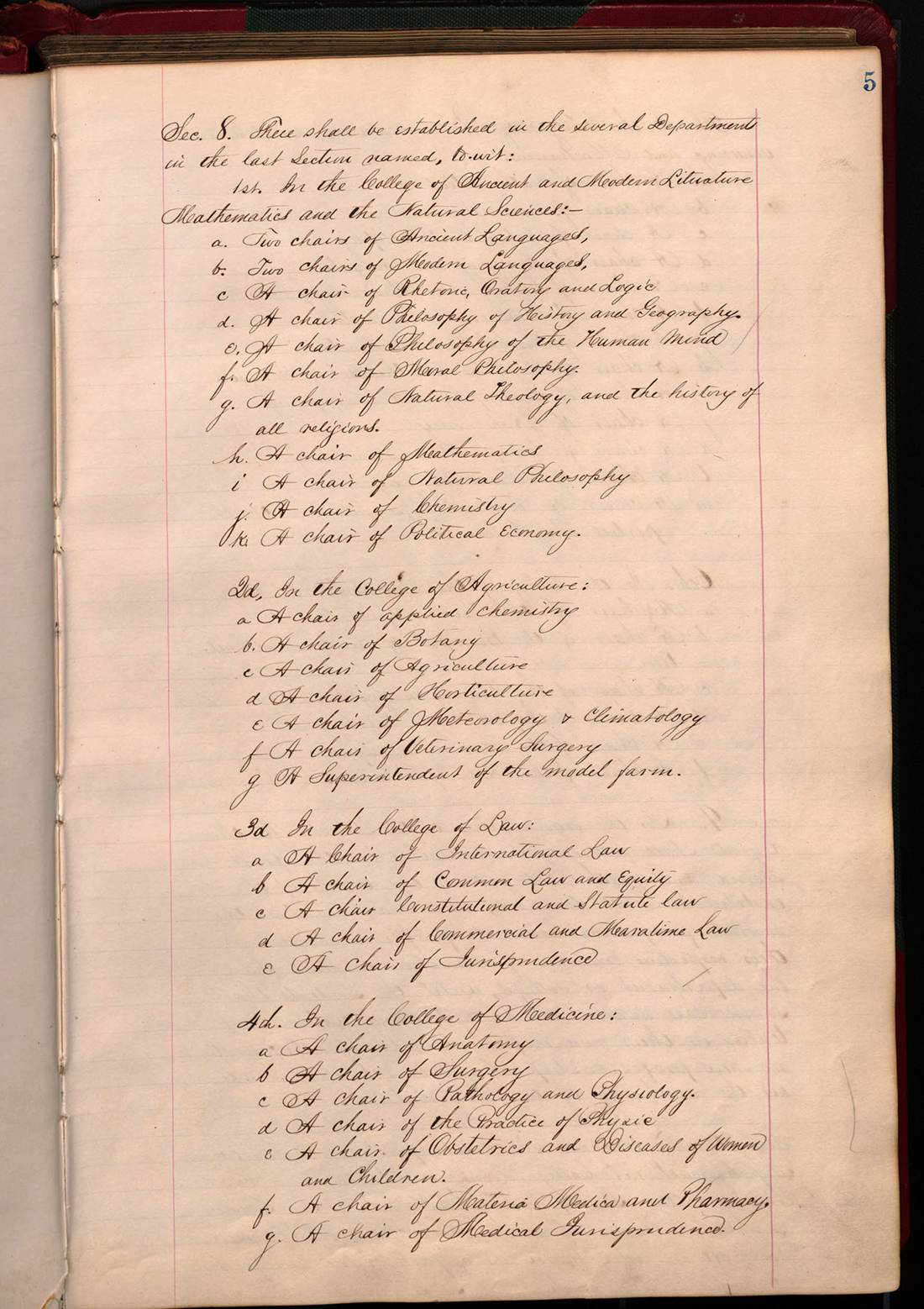
Section 8
There shall be established in the several departments in the last section named, to wit:
First, in the College of Ancient and Modern Literature, Mathematics and the Natural Sciences:
- Two chairs of Ancient Languages.
- Two chairs of Modern Languages,
- A chair of Rhetoric, Oratory and Logic,
- A chair of Philosophy of History and Geography,
- A chair of Philosophy of the Human Mind,
- A chair of Moral Philosophy,
- A chair of Natural Theology and the history of all religions
- A chair of Mathematics
- A chair of Natural Philosophy
- A chair of Chemistry
- A chair of Political Economy.
Second, in the College of Agriculture:
- A chair of applied chemistry
- A chair of Botany
- A chair of Agriculture
- A chair of Horticulture
- A chair of Meteorology and Climatology
- A chair of Veterinary Surgery
- A superintendent of the model farm.
Third, in the College of Law:
- A chair of International Law
- A chair of Common Law and Equity
- A chair of Constitutional and Statute Law
- A chair of Commercial and Maritime Law
- A chair of Jurisprudence.
Fourth, in the College of Medicine:
- A chair of Anatomy
- A chair of Surgery
- A chair of Pathology and Physiology
- A chair of the Practice of Physics
- A chair of Obstetrics and Diseases of Women and Children
- A chair of Materia Medica and Pharmacy
- A chair of Medical Jurisprudence
Fifth, in the College of Practical Science, Civil Engineering and Mechanical:
- A chair of Mathematics
- A chair of Chemistry
- A chair of Natural Philosophy
- A chair of Surveying and Navigation
- A chair of Geology and Mineralogy
- A chair of Engineering Construction
- A chair of Architectural Construction
- A chair of Drawing and the Art of Design
- A chair of Geography and Mapping
- A chair of Astronomy
- A chair of Comparative Anatomy
- A chair of Metallurgy
- A chair of Practical Experiments in the Properties of Materials.
Sixth, in the College of Fine Arts:
- A chair of the History of Arts
- A chair of the Principles of Painting and Sculpture
- A chair of the Principles of Music
- A chair of the Art of Painting
- A chair of the Art of Sculpture
- A chair of the Art of Music.
Section 9
In the organization of the University, the Regents shall fill only such chairs in the first, second and fifth colleges as the wants of the institution shall demand, and may require the several professors chosen to perform duties in their respective branches of education in more than one department or college, until the students shall so increase in number as to demand exclusive attention in their own respective departments; and no new professorship shall be established without the authority of the Legislature.
Section 10
The Governor shall set apart two sections of any Agricultural College land or saline land belonging to the state, and shall notify the State Land Commissioner of such reservation, for the purpose of a model farm as a part of the College of Agriculture; and such land so set apart shall not be disposed of for any other purpose.
Section 11
The several buildings of the university shall all be erected within a radius of four miles from the State House.
Section 12
The Regents shall, when the number of students in any particular branch of study shall require, elect one or more tutors to give instruction in such branch of study; but such tutors shall not be considered as belonging to the faculty of the college in which they may be employed.
Section 13
The immediate government of each college shall be by its own faculty, which shall consist of the professors therein, but no course of study shall be adopted or series of text books used without the approval of the Board of Regents.
Section 14
The Board of Regents shall have exclusive authority to confer degrees and grant diplomas, but each college may in its discretion grant rewards of merit to its own students. No student shall, upon graduation, receive any diploma or degree unless he shall have been recommended for such honor by the faculty of the college in which he shall have pursued his studies. The Regents shall also have power to confer the usual honorary degrees upon other persons than graduates of this university, in recognition of their learning or devotion to literature, science or art; but no degree shall be conferred in consideration of the payment of money or other valuable thing.
Section 15
The fee of admission to any college in the university shall be five dollars each for all persons. A reasonable course of study precedent to admissions hall be prescribed by the Board of Regents, and no applicant who shall fail to pass an examination in any part of such course shall be admitted; provided any person who shall produce a certificate from a County Superintendent of Common Schools that he has passed honorably through the course of study prescribed in a high school, under the common school laws of the state, may be admitted without further examination.
Section 16
All persons residing within the state, or being non-residents, who pay or whose parents or guardians pay not less than thirty dollars annually of school taxes to the state, and who shall fill the requirements of the preceding section, may be admitted to any organized college of the university, and shall not be required to pay any other tuition fee than the matriculation fee during the term of four years; all other students, and all who elect to remain under instruction for a longer term than four years, shall be required to pay such fees as the Board of Regents may determine.
Section 17
The Regents shall procure all text books to be used in the university and shall furnish them to the students at cost. The Regents may upon proper evidence of the good character of any student and his or her ambition to acquire an education and inability to provide his or her own means therefor donate to such student all text books he or she may need, and, by a two-thirds vote, may appropriate money to pay other expenses for such student; provided such students will render an immediate equivalent in personal service for such appropriation, is give a sufficient obligation that he or she will reimburse the regents within five years.
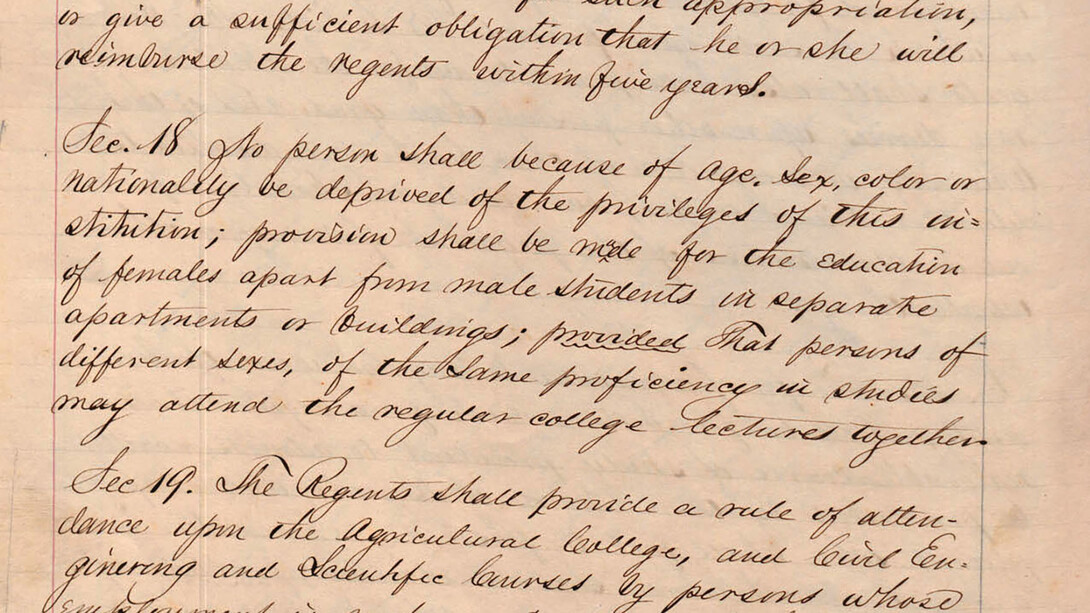
Section 18
No person shall because of age, sex, color or nationality be deprived of the privileges of this institution; provision shall be made for the education of females apart from male students in separate apartments or buildings; provided that persons of different sexes, of the same proficiency in studies may attend the regular college lectures together.
Section 19
The Regents shall provide a rule of attendance upon the Agricultural College, and Civil Engineering and Scientific courses by persons whose employment is such as to allow of their pursuit of study only a portion of the year.
Section 20
The Board of Regents shall transmit on the first day of January preceding each regular session of the Legislature, to the Governor, to accompany his message, a printed report of all their doings since their last report, giving in detail all receipts and expenditures of money, and furnishing an estimate for future income and expenses, a catalogue of professors, officers and students at the commencement of the last summer vacation, and such other information with recommendations as will apprise the Legislature fully of the condition and wants of the university.
Section 21
The Friends of the University shall be two, to with: The Endowment Fund and the Regents Fund.
The Endowment Fund shall be kept in two accounts: that derived from the proceeds of the sale of lands donated to the state by the United States, “to establish and endow a State University,” under the act of Congress of April 19, 1864, in one account: and that derived from the proceeds of sales of land donated to the state by the United States, to provide “colleges for the benefit of agriculture and the mechanic arts,” by an act of Congress approved July 2nd,1862, in another account; to the funds received from these two sources there shall be added to the first two-thirds and to the second one third of the proceeds of all lands or of all moneys acquired by donation or bequest when other object is not started, and of the fees for admission to the university; All moneys so received, shall be invested as fast as five hundred dollars shall accumulate, in such United States or guaranteed state stocks as will pay not less than six per century annually; and the principal of such investments hall never be appropriated by the Legislature or used by the Regents for any purpose whatever.
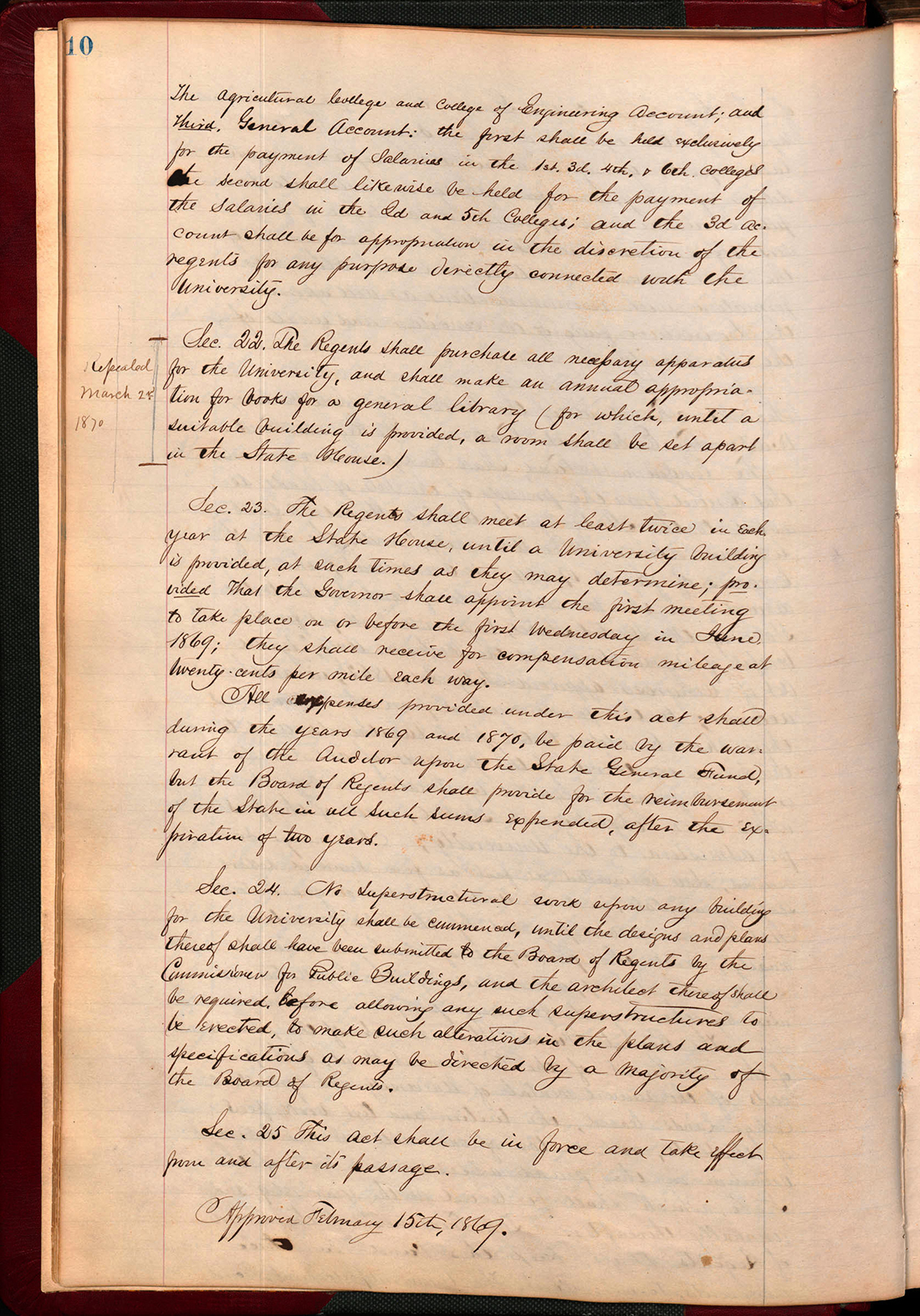
The Regents fund shall consist of the proceeds of the investment of the Endowment Fund of the proceeds of the annual rental of University and Agricultural College lands lease, the tuition and text book fees of students, and a tax of one mill on the dollar valuation of the grand assessment roll of the state, which shall be levied in the year 1869, and annually thereafter. The Treasurer of the Board of Regents shall keep this fund in three accounts, to wit: First, the University Account; second, the Agricultural College and College of Engineering Account; and third, General Account: the first shall be held exclusively for the payment of salaries in the first, third, fourth and sixth colleges. The second shall likewise be held for the payment of the salaries in the second and fifth colleges; and the third account shall be for appropriation in the discretion of the Regents for any purpose directly connected with the university.
Section 22
The Regents shall purchase all necessary apparatus for the university, and shall make an annual appropriation for the university, and shall make an annual appropriation for books for a general library for which, until a suitable building is provided, a room shall be set apart in the State House.
Section 23
The Regents shall meet at least twice in each year at the State House, until a university building is provided, at such times as they may determine; provided that the governor shall appoint the first meeting to take place on or before the first Wednesday in June 1869; they shall receive for compensation mileage at twenty cents per mile each way.
All expenses provided under this act shall during the years 1869 and 1870 be paid by the warrant of the auditor upon the State General Fund, but the Board of Regents shall provide for the reimbursement of the state in all such sums expended, after the expiration of two years.
Section 24
No superstructural work upon any building for the university shall be commenced until the designs and plans thereof shall have been submitted to the Board of Regents by the Commissioner for Public Buildings, and the architect thereof shall be required before allowing any such superstructures to be erected, to make such alterations in the plans and specification as may be directed by a majority of the Board of Regents.
Section 25
This act shall be in force and take effect from and after its passage.
Approved February 15, 1869.
Share
Tags
High Resolution Photos
HIGH RESOLUTION PHOTOS
HIGH RESOLUTION PHOTOS
HIGH RESOLUTION PHOTOS
HIGH RESOLUTION PHOTOS
HIGH RESOLUTION PHOTOS
HIGH RESOLUTION PHOTOS
HIGH RESOLUTION PHOTOS
HIGH RESOLUTION PHOTOS