Every sip of water or coffee might come with something extra — particles so small they can’t be seen, tasted or felt. Scientists now believe those invisible fragments, known as microplastics and nanoplastics, could be entering human bodies more often than people realize.
A new project, with six researchers from across the University of Nebraska system, aims to answer a simple but urgent question: How much of these plastics are people consuming?
Backed by a three-year, $1,479,178 grant from the National Institute of Environmental Health Sciences, the study focuses on the release of tiny plastic particles from everyday beverage containers — like bottles that hold water or soft drinks, and takeout coffee cups.
The work builds on earlier efforts under a Grand Challenges initiative and brings together engineers, health scientists and behavior experts to tackle the issue from multiple angles.
The team includes researchers from the University of Nebraska–Lincoln and the University of Nebraska Medical Center, with unique areas of expertise that will impact the study:
- Lucia Fernandez-Ballester, associate professor of mechanical and materials engineering at Nebraska — the polymers used in drinking containers;
- Seulki Kim, assistant professor of sociology at Nebraska — social behaviors of consumers;
- Yusong Li, professor of civil and environmental engineering at Nebraska — release rates of micro- and nanoplastics;
- Yongfeng Lu, Lott Distinguished Professor of electrical and computer engineering at Nebraska — a unique laser-based technique that will replicate the release of micro- and nanoplastics;
- Svetlana Romanova, research assistant professor, Department of Pharmaceutical Sciences at UNMC — the biological effects of micro- and nanoplastics;
- Bing Wang, associate professor of food science and technology at Nebraska — risk assessment.
For Li, the stakes are clear.
“This is directly about what you drink, and we drink a lot and that could impact the health of likely millions and millions of people,” Li said.

At the center of the research is a critical concept: the release rate of plastic particles into liquids under different conditions. Measuring those rates allows scientists to move beyond general concern and begin quantifying real-world exposure.
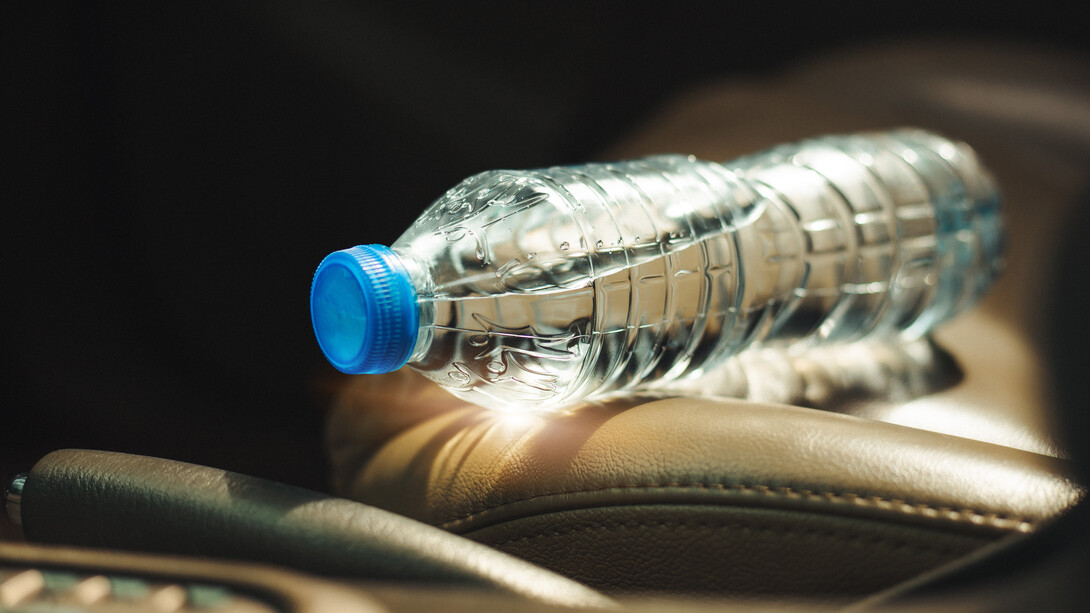
Li said everyday scenarios can make a difference. Heating containers, leaving bottles in hot environments or reusing plastics repeatedly may all increase how many particles are released. By studying these patterns, the team hopes to identify which habits carry the most risk — and which changes could reduce it.
That level of detail matters because not all plastics behave the same under similar conditions.
“What type of material, how it was processed … it may have different release behavior,” Fernandez-Ballester said.
In practical terms, this means two similar-looking bottles could expose users to very different amounts of microplastics. Understanding these differences could eventually guide manufacturers toward safer designs and help consumers make more informed choices.
But measuring exposure is only part of the challenge. To understand potential health effects, researchers also need to study how these particles interact with the body. That requires far more material than typical use conditions produce.
That’s where Lu’s work comes in. Using an advanced laser-based technique, his lab can generate large quantities of micro- and nanoplastics that closely resemble those released from real containers.
“We can produce the particles we need in hours instead of months and years,” Lu said.
This breakthrough allows scientists to conduct more realistic toxicity studies, rather than relying on uniform, commercially produced particles that may not reflect what people ingest. As a result, the research can better connect how much plastic is released with what it might do inside the body.
The project’s collaborative structure is key to its ambition. Engineers measure release rates and identify particles, materials scientists analyze plastic properties, and health researchers assess biological effects.
“I think the strength of this project is the team,” Lu said. “The combination makes us unique.”
Ultimately, the goal is not just to understand microplastics, but to translate that knowledge into practical guidance. By identifying how daily habits influence exposure, the team hopes to provide evidence-based recommendations that people can use in their everyday lives.
“We will collaborate with manufacturers, and the results of this project will be translated and shared with them, and our findings will also be communicated to early childhood educators, with whom we also work closely,” Li said.
For now, the work is just beginning. But with billions of people relying on plastic beverage containers every day, even small insights could add up to a major impact — one sip at a time.
Share
News Release Contact(s)
Tags
- microplastics
- nanoplastics
- civil and environmental engineering
- Electrical and Computer Engineering
- mechanical and materials engineering
- Engineering
- Sociology
- Food Science and Technology
- Arts and Sciences
- IANR
- UNMC
- Lucia Fernandez-Ballester
- Seulki Kim
- Yusong Li
- Yongfeng Lu
- Svetlana Romanova
- Bing Wang
- faculty
- research