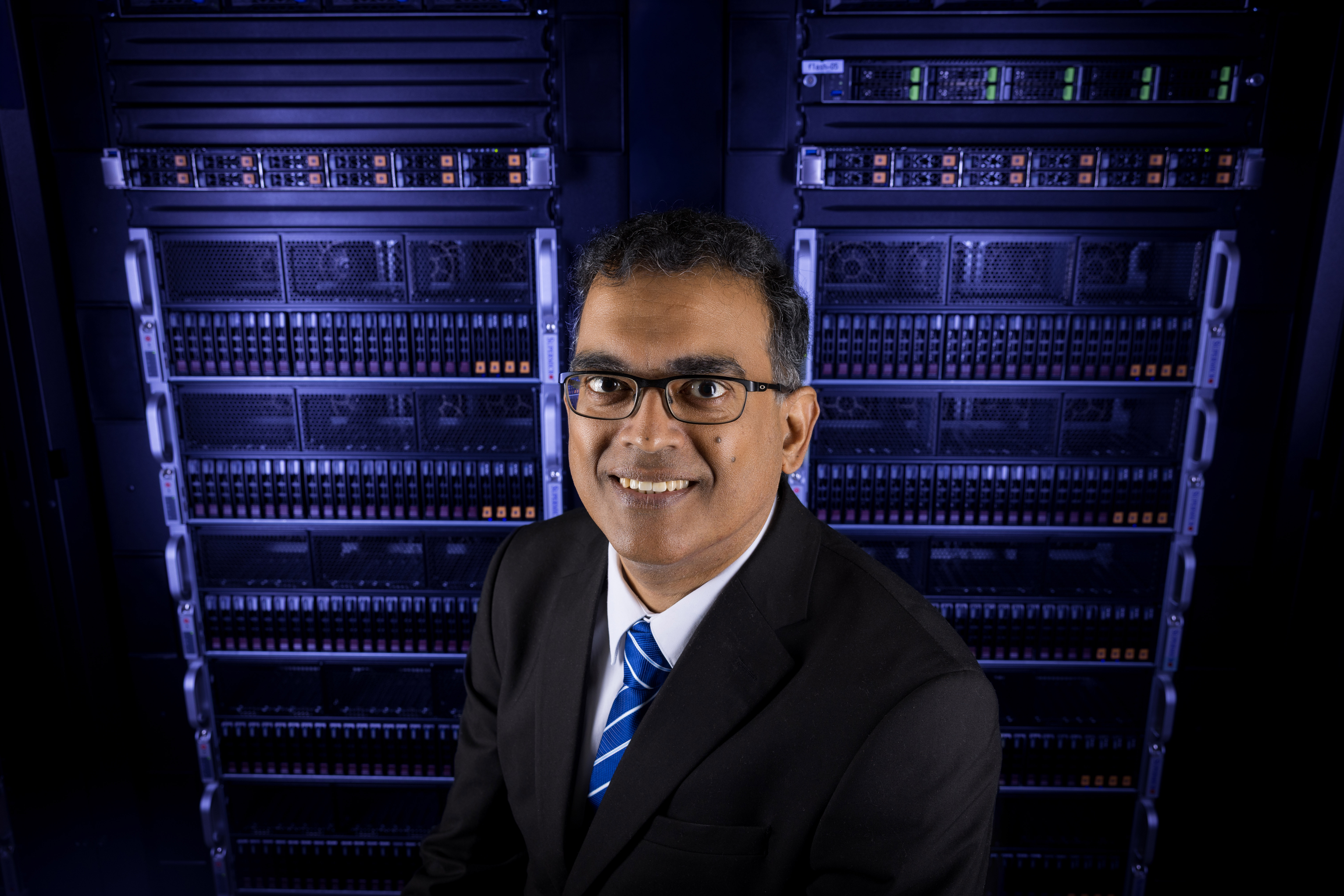
A Husker computer scientist is leading three projects aimed at advancing the speed, intelligence and efficiency of data networks — research that sits at the intersection of artificial intelligence and next-generation connectivity.
The three projects, funded by agencies including the National Science Foundation and the U.S. Department of Energy, focus on the same overarching challenge: managing and analyzing the massive volumes of data that flow through modern scientific and digital infrastructure.
Byrav Ramamurthy, professor of computing at the University of Nebraska–Lincoln and principal investigator, said two of the projects focus on using AI and machine learning to make sense of complex, high-volume datasets. One NSF-funded project applies AI tools to routing logs from Internet2 — the nationwide research and education backbone that connects universities and labs — to classify traffic, detect anomalies and better understand how data moves across large networks.
A DOE-supported project uses machine learning to analyze caching logs from the Open Science Grid, which distributes data from the Large Hadron Collider, the world’s most powerful particle accelerator. By predicting which files will be requested next, the Nebraska team aims to prefetch and store data more efficiently, reducing bottlenecks for high-energy physics experiments.
The third project focuses on the future of high-speed optical networks. Supported by NSF, the research explores new technologies that could make fiber-optic systems faster, more energy-efficient and more cost-effective — improvements increasingly critical as global data needs continue to soar.
High-speed networks are foundational for AI advancement, with distributed applications often spanning multiple sites and relying on high-bandwidth connectivity. Large network infrastructures at universities and other research institutions generate enormous amounts of data requiring machine learning-based analysis.
“AI is a good tool,” Ramamurthy said. “Sometimes people have apprehension about the role of AI, and I do have some concerns myself, but there are some things, especially large data, big data, for which there’s no other way. Humans cannot analyze the large traffic data from routers.
“It is really amazing what AI can do with large volumes of data.”
High-speed networks enable these capabilities, Ramamurthy said. As AI models grow and scientific facilities generate ever larger datasets, he believes advances in both wired and wireless connectivity will be crucial to supporting the next era of discovery.
Ramamurthy’s collaborators include his three doctoral students (Sarat Barla, MAU Shariff and Srikar Chanamolu); researchers from the Indian Institute of Technology Madras, on the optical network project; and Derek Weitzel, research associate professor of computing at Nebraska, on the Open Science Grid research. The Holland Computing Center is also involved in the project.
Share
News Release Contact(s)
Tags
High Resolution Photos