With scientific breakthroughs, there is often a "eureka" moment when a researcher first realizes a process or technology can solve a problem. It’s no different with breakthroughs supporting the safety and well-being of warfighters. These are moments that make headlines — big discoveries that tell us a better world or a smarter, stronger, safer soldier is possible.
"We often forget the hard work doesn’t end with 'eureka,'" said Marty Sikes, associate executive director of chemical and biological defense programs at the National Strategic Research Institute at the University of Nebraska. "There is an important space between revolutionary discoveries and fielding innovative and timely solutions. This critical space is one that NSRI and its partners are uniquely positioned to fill."
An essential collaborator in helping NSRI close that gap in biological processes contributing to national security is the Biological Process Development Facility in the University of Nebraska–Lincoln's College of Engineering. In addition to a wide range of other biological development work, the facility develops, tests and documents processes that turn raw, one-time laboratory products into practical, large-scale manufacturable defense-related products.
Staffed by experts with decades of academic and commercial experience, and equipped with cutting-edge technology, the facility is perfectly situated to provide the missing link that transforms brilliant ideas into real-world solutions.
"Time and again, the BPDF has served a critical role in our national security work with federal government agencies," Sikes said. "With recent investments from NSRI and UNL, it is going to continue to be a partner in executing and innovating for the Department of War."
About the Biological Process Development Facility
Beginning as a protein research laboratory in the mid-90s, the facility has expanded to a broad range of biological research and development projects, specifically tailoring its capabilities to provide much-needed support to researchers, students, defense agencies and commercial manufacturers.
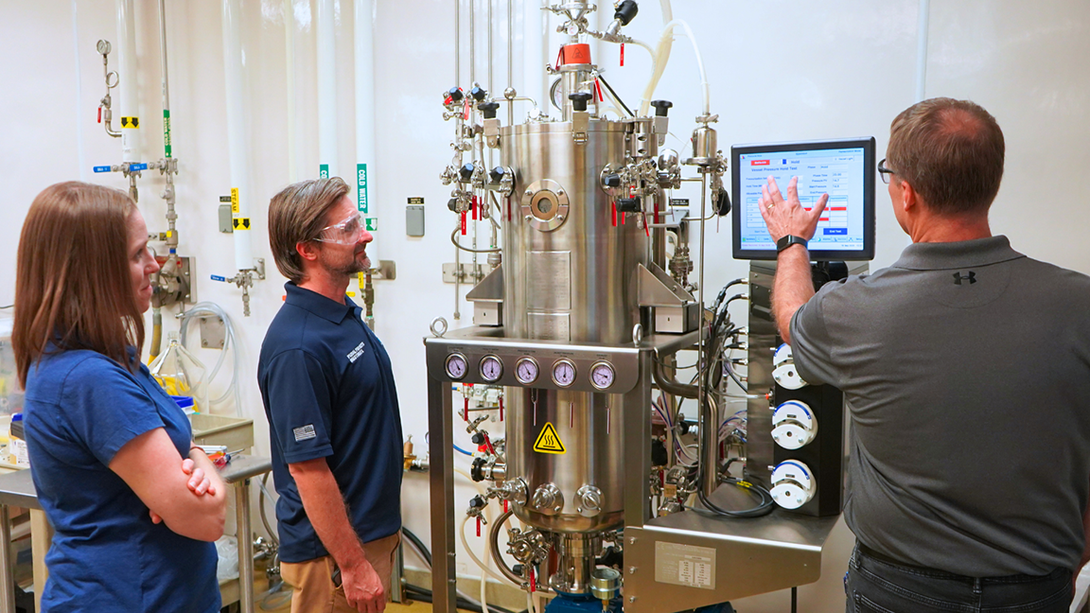
The facility specializes in microbial expression systems — working with the materials microorganisms produce. Using advanced onsite equipment and applications, the facility uses genetically engineered organisms such as bacteria and yeast to produce a specific protein, enzyme or other material of interest. This could be the active ingredient in a vaccine or biotherapeutic, or an intermediate to be used for further processing.
Although the facility provides support for projects in all stages, one compelling aspect of the facility is its Good Manufacturing Practice operation, which ensures developed products can be manufactured for safe human use.
"Anything produced for human use — injectables, oral medications and more — needs to be produced under GMP,” said Dennis Hensen, facility director. “It includes operating under a quality system and quality assurance program and having standard operating procedures to make sure you’re doing things the right way and ensure the process is documented and reproducible."
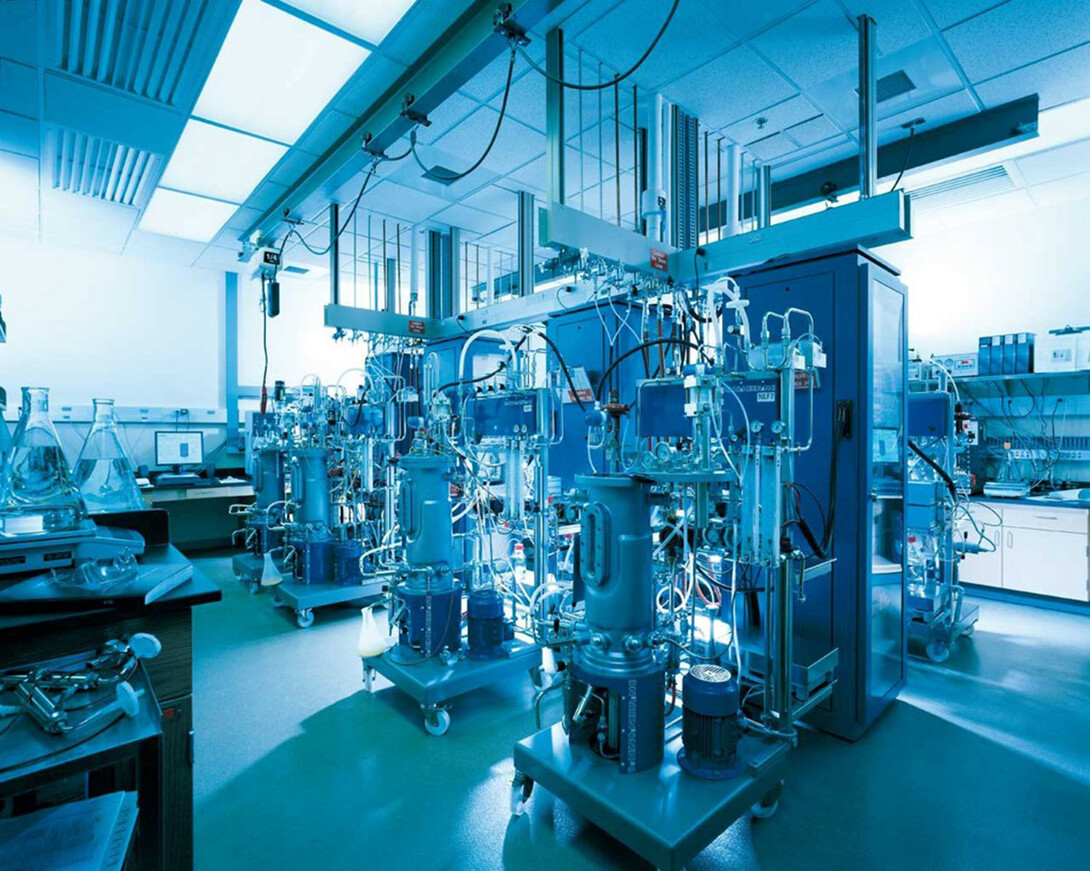
The facility’s Good Manufacturing Practice facility is equipped with impressive systems to help facilitate production, including isolated hot and cold water loops for process temperature control, more than 6,000 square feet of clean room space, which includes a purification suite to isolate the target materials.
One unique feature is the facility's ability to produce ultra-pure water for injection within the building as a medium for injections — a capability that proved useful during the COVID-19 pandemic.
"During COVID, finding and acquiring raw materials to do anything in the lab was very difficult," Hensen said, "but thanks to our WFI system, water for injections and for a processing input was one thing we didn’t have to worry about."
The system takes water collected through reverse osmosis — already very clean — and further purifies it through a process of steam and condensation, creating an ultra-pure water that can be injected into a person’s body without fear of causing additional complications.
The facility features dedicated steam and process gas lines and an uninterruptible power supply and backup generator to ensure critical equipment stays online in the event of an outage.
These assurances are concrete examples of the BPDF’s dedication to quality assurance, which it brings to a wide variety of projects. The facility also has access to a broad pool of multidisciplinary university researchers across the University of Nebraska's four campuses.
"We have flexibility that larger contract manufacturing organizations don’t have," Hensen said. "If there’s a change needed during a project, we’re able to pivot on the fly and collaborate to find solutions."
Contributions to American defenders
UNL’s BPDF has contributed to DOW research for several years through NSRI, one of 15 DOW-designated University Affiliated Research Centers in the country.
"Everything I’ve done there has been essential to my efforts to support our DOW sponsors," said Zachary Minter, NSRI senior scientist. "Whether that’s been to grow large volumes of bacterial spores, vegetative bacteria or conduct experiments using BPDF-specific equipment."
Minter explained that the facility has high-capacity, pilot-level fermentation equipment that allows researchers to fulfill tasks, and the staff are all subject matter experts.
"Studying the processes of fermentations at larger volumes can only be done at certain places — it’s work that just cannot be done at that scale without a place like BPDF,” he said.
The facility’s familiarity with DOW work makes things move smoothly.
In anticipation of a long-term partnership, the BPDF and NSRI have invested to further develop the facility to meet DOW project needs.
"Recently, we were working on a project that needed an upgraded piece of equipment. NSRI and UNL co-purchased that equipment for the lab," Minter said. "We’re upgrading the space together, which will extend our working relationship far into the future."
From biological breakthroughs to everyday application
Turning the complicated process of scientific discovery into efficient, accurate and repeatable large-scale processes is no small feat, but it is essential to producing practical applications that make the Nation and its warfighters more resilient against biological threats.
"This is the perfect location to work on these programs," Minter said. "We wouldn’t be able to fulfill the requirements of these projects without access to the BPDF."
As increasingly complex security challenges present in the coming years, the BPDF’s highly specialized resources will offer a unique edge in the search for strategic resilience. Backed by long collaboration with NSRI and a unique mix of academic and professional expertise, the BPDF stands ready to meet the most difficult national security challenges head-on with agility, creativity and precision.