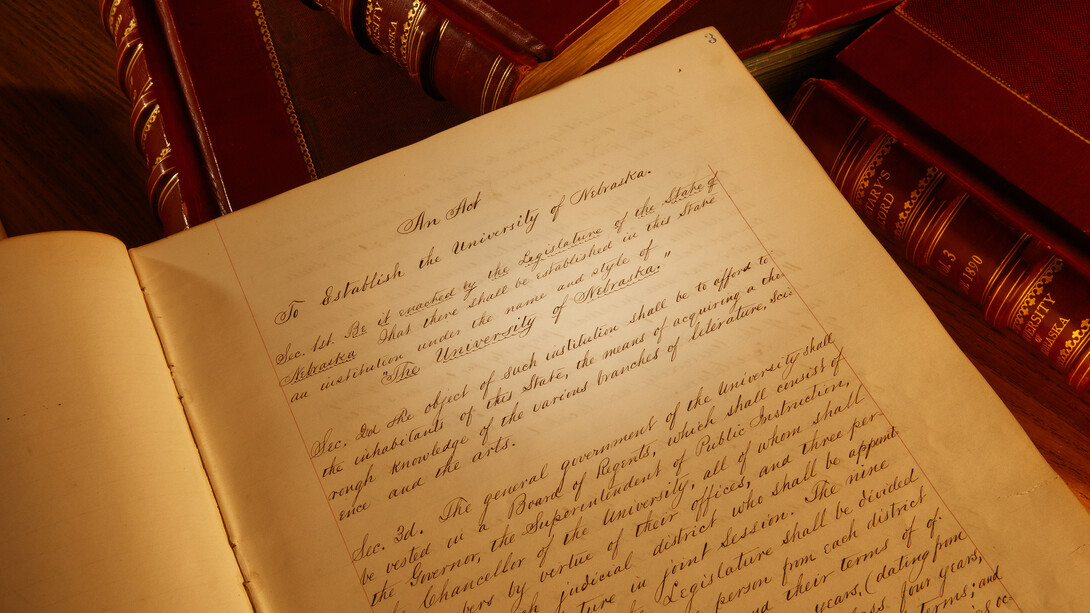
Some 157 years ago today, Feb. 15, in a burst of legislative efficiency, Nebraska gave birth to Dear Old Nebraska U.
The charter that created the University of Nebraska was approved in a single day — but its roots stretched back decades, weaving through territorial ambition, the Morrill Act and even the educational philosophy of Thomas Jefferson.
Not a first attempt
Nebraska’s dream of a state university didn’t begin in 1869. In 1855, Acting Governor T.A. Cumming urged the territorial legislature to establish one. Over the next decade, more than two dozen charters were issued to create “Nebraska University” in towns across the territory.
The idea proved so popular — and so speculative — that legislators had blank charters printed to hand out to developers. Yet despite the enthusiasm, none of those early efforts took root. The university Nebraska envisioned remained just that — a vision.
A capital and a commitment
Everything changed in 1867. An act establishing Lincoln as the state capital also declared that the university would call the new city home. It further united the State University and the State Agricultural College into a single institution — a forward-thinking move that aligned Nebraska with the land-grant ideals of the Morrill Act.
To underscore Lincoln’s importance, lawmakers also placed the penitentiary and the state’s insane asylum in the new capital. Nebraska wasn’t just building a city — it was building infrastructure for a state.
A day that made history
The university officially came into existence when Nebraska’s first state legislature convened in Omaha in 1869. On Feb. 15 of that year, in a flurry of action, the two-house legislature unanimously approved the university’s charter and sent it to the governor for signature.
The timing mattered. Under the Morrill Act, states had three years from statehood to claim federal land grants and two additional years to establish a functioning university. Nebraska met both deadlines. The charter allowed the state to claim 136,080 acres — land that would be sold or leased to fund the new institution.
A university was no longer an idea. It was law.
Inspired by Michigan — and Jefferson
The bill was written by Augustus Harvey, a legislator from Nebraska City. In crafting it, Harvey looked north for guidance, modeling Nebraska’s charter after the University of Michigan — then one of the nation’s strongest public universities.
Michigan’s own 1837 charter traced its origins to a document by U.S. Circuit Judge Augustus Woodward, who had consulted with Thomas Jefferson while the University of Virginia was being planned. Through this intellectual lineage, Nebraska’s university carried forward Jefferson’s belief in broad, public education as a cornerstone of democracy.
Expanding the Morrill vision
Nebraska didn’t merely adopt the Morrill Act — it expanded it.
The charter declared that the university would serve “the inhabitants of the state,” not just citizens or young men. It promised access to “a thorough knowledge of the various branches of literature, science and the arts.”
From its very first day of classes, women enrolled alongside men. Regardless of age, sex, color or nationality, the university opened its doors wider than many of its peers.
Building the framework
Governance of the university was placed in the hands of 12 regents: nine representing judicial districts, joined by the governor, state superintendent of public institutions and the university’s chancellor. The structure evolved over time; by 1877, the board was reduced to six regents elected by the public.
The first board met June 3, 1869, to organize and plan the university’s inaugural building. In September, members gathered again to lay the cornerstone of University Hall — a tangible sign that Nebraska’s long-imagined university was finally rising from the prairie.
The first college
The charter established six departments, ranging from Agriculture and Law to Medicine and Fine Arts. The first to open was the College of Ancient and Modern Literature, Mathematics and the Natural Sciences in fall 1871.
Now known as the College of Arts and Sciences, it remains among the university’s largest colleges, enrolling more than 3,100 undergraduates and 700-plus graduate students. With more than 440 faculty across 59 departments and units, and more than 50,000 alumni worldwide, it stands as a living testament to the ambition of that 1869 charter.
A living document
As the university marks 157 years since its founding charter was approved, the document that made it all possible remains available for public viewing — online, at the University Archives and Special Collections, and in the records room at the State Capitol.
What began as a stack of paper in a legislative chamber became an institution that has shaped generations.
And it all started in a single, extraordinary day.
Editor’s Note — Information for this story was gathered from the original university charter, “Prairie University” by Robert Knoll, and “Dear Old Nebraska U: Celebrating 150 Years” by Kim Hachiya and Craig Chandler.


