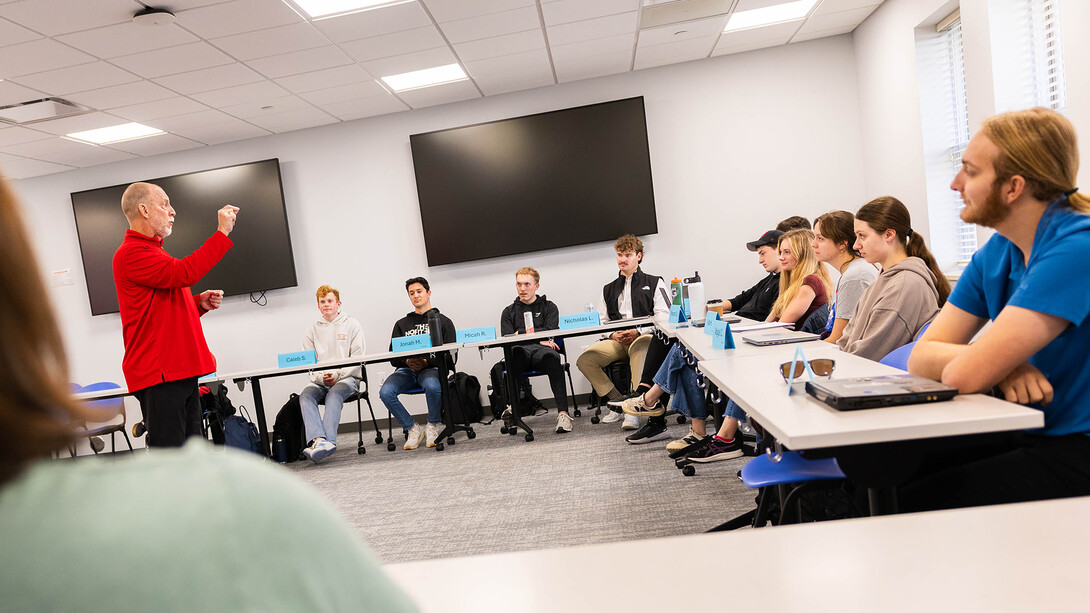
Recently, a very special guest visited the University Honors Program upperclass seminar “Space Odyssey: Surveying the Past, Present, and Future of Outer Space” when astronaut, aerospace engineer and author Clayton Anderson joined the students.
The class, taught by Director of Externships and lecturer for the Nebraska College of Law Elsbeth Magilton, aims to teach students about the history of the space industry, international relations in space and the ethics of space exploration.
“Having a NASA astronaut come in and talk about what their journey to being an astronaut looked like really brought some of our readings and curriculum to life,” Magilton said.
According to Magilton, much of the class covers the logistics of space habitation. Anderson lived on the International Space Station for 167 days across two missions. He spent 152 days on the ISS during a mission in 2007, and he later returned for 15 more days in 2010.
“He has that experience of what that really looks like day-to-day,” Magilton said. “Different [space industry] businesses make lots of promises, and then we have this guy telling us he had to be strapped down to go to the bathroom. That doesn’t really sound like the hotel spa experience these companies are saying they’re going to give.”
Magilton said that having Anderson in to speak helped bridge the gap between abstract, “far-out” concepts and real life. Hearing from someone who had lived the experiences about which students learned in the class allowed them to create a more well-rounded understanding of course topics. Magilton also reported that many of her students enjoyed the experience more than they expected.
Fourth-year computer science major Walker Lee said that Anderson’s passion about space exploration allowed him to connect with what Anderson said.
“Hearing Clayton talking about persistence struck a chord with me," Lee said.
Lee said he resonated with Anderson’s message about the lessons he learned through his time in space and appreciated Anderson’s honesty about his experiences.
“I think when you hear an astronaut is coming, you expect it to be a politician who’s coming in to smooth talk all the good talking points about the US Space Program,” Magilton said. “And Clayton does that to a certain extent. He’s a very talented speaker, but he’s also really candid and really funny. I think the students got comfortable quickly.”
Overall, Magilton and Lee agreed that Anderson’s insight helped take the classroom experience to the next level, increasing student understanding and bringing the material to life.