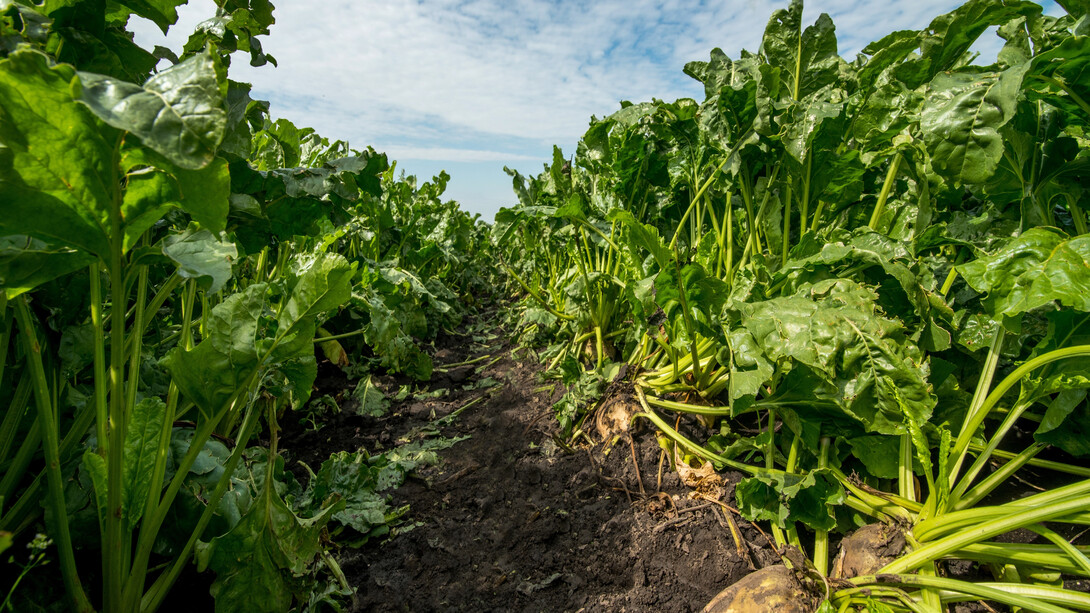
Palmer amaranth, a fast-growing “superweed,” is notorious for the destructive threat it poses to sugar beet production. The plant produces enormous quantities of seeds, spreads easily and has developed resistance to most herbicides. Once the weed asserts itself in a field, the yield losses are often staggering.

Until recently, the plant, Amaranthus palmeri, did not have a major presence in western Nebraska. But early this decade, Nevin Lawrence — a scientist working at the University of Nebraska–Lincoln’s Panhandle Research, Extension and Education Center in Scottsbluff — began pointing to the possible threat. His pioneering scientific findings and partnership with Western Sugar Cooperative, a regional grower-owned sugar beet association, helped head off a major outbreak.
Lawrence, associate professor of agronomy and horticulture, generated the only dataset available on the herbicide ingredient metamitron while investigating its potential use against Palmer amaranth. He worked out the optimal use rate for effective protection and shared his findings with Western Sugar, saying preventive action was needed against the threat.
The work helped convince the Environmental Protection Agency to approve emergency use in Nebraska and Colorado of the herbicide Goltix (metamitron is its active ingredient) for three straight years, including 2026.
Safeguarding plants from the superweed threat is a central need for the sugar beet industry. Documented yield losses from uncontrolled Palmer amaranth have totaled 30% or more in Nebraska and Colorado, the U.S. Department of Agriculture reports. Some test sites have shown losses as high as 47%.
Research indicates that if left uncontrolled, Palmer amaranth potentially can lead to average yield losses exceeding 70%.
In the face of this threat, Lawrence’s pioneering work provided a scientific contribution of direct value to industry.
“It was timely, high-stakes work that helped protect a crop critical to the western region,” said Martha Mamo, head of the Department of Agronomy and Horticulture. “Nevin’s work preserved grower options and contributed to savings in the millions of dollars while helping safeguard farm livelihoods.”
The Nebraska Beet Growers Association last year saluted Lawrence for helping the industry safeguard production from Palmer amaranth.
“The level of commitment and ingenuity is quite unique to Nevin, and he deserves a huge debt of gratitude,” said Rebecca Larson, Western Sugar's chief scientist.
About half of the cooperative’s members used Goltix in 2024, resulting in added revenue exceeding $8 million, she said.
Weed control is a challenge overall for sugar beet production, and in 2018, the crop production company ADAMA sent samples of their herbicide Goltix to Lawrence and other weed scientists, asking them to test it against Palmer amaranth. While other weed experts did not see Goltix as effective, Lawrence’s research indicated that the herbicide offered impressive protection.
Palmer amaranth at that point was not a significant problem, but Lawrence saw the need to keep a focus on the threat. He approached Western Sugar, saying the superweed threat was likely to intensify and that Goltix provided great potential for a solution. The cooperative, whose membership includes producers in Nebraska, Colorado, Montana and Wyoming, approved funding, enabling Lawrence to proceed with his research.
Lawrence’s analytical work on Goltix proved crucial. He determined an optimal use rate that met three key requirements: effective protection by disrupting the weed’s photosynthesis; an application rate low enough to qualify for EPA approval; and affordability for producers.
He followed up by developing a season-long weed control strategy by which Goltix application suppressed Palmer for six to eight weeks, after which other herbicides could be effectively used.
Still, a regulatory hurdle remained. The EPA needed to be convinced to give emergency Section 18 approval for Goltix use, since the only regulatory data for it was from the European Union.
Approval of a Section 18 designation requires proof that there is an emergency, that the requested pesticide is highly effective and that there is no other option.
“My work on Goltix showed it was effective, and my other work in sugar beet showed that there was no other option,” Lawrence said.
Western Sugar cited that all-important information in making the case to the EPA. The Nebraska Department of Agriculture then made the formal request to the agency, which approved emergency use.
“What began as uncertain, difficult work by Nevin has now become a high-return contribution with real and expanding impact,” Mamo said. “The herbicide formulation is now moving into use in other states, which further underscores the value, credibility and broader relevance of his research.”
Agriculture in western Nebraska is distinctive regarding the environment, the crops grown and the agricultural practices, Lawrence said. That is why the university places major ag-research and extension presence there, to tailor assistance to local needs.
“This is the mission of the land-grant institution, to do locally relevant research to benefit the needs of local stakeholders,” he said. “This is the priority of what we do — serve the needs of western Nebraska.”
Share
Related Links
Tags
High Resolution Photos