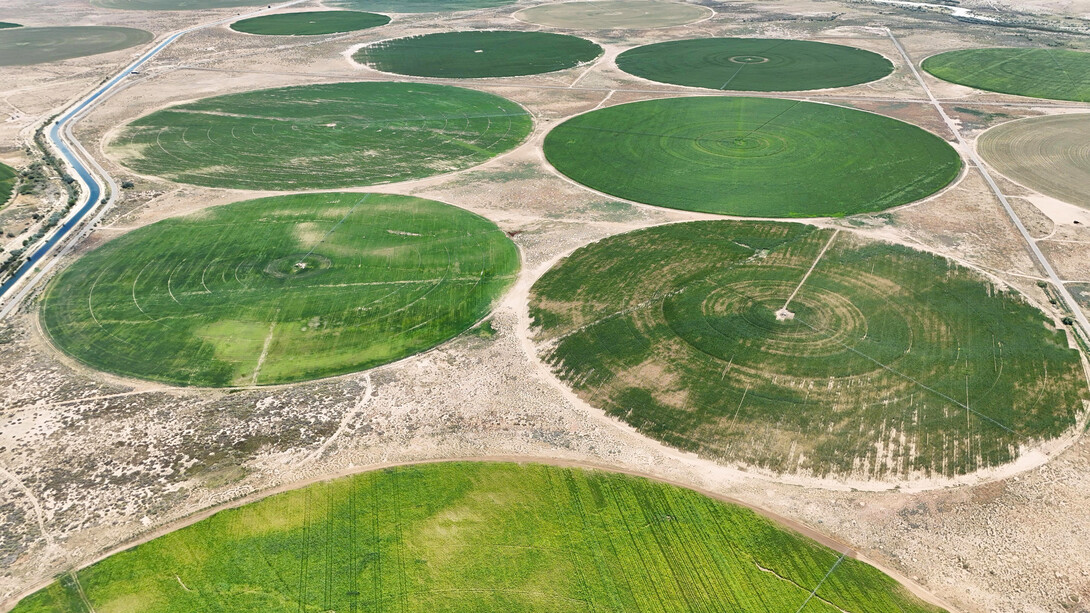
A new study by researchers at the Daugherty Water for Food Global Institute at the University of Nebraska offers a comprehensive national-scale assessment of irrigated agriculture in the United States in recent years. Published in Agricultural Water Management, the findings carry important implications for the future of food production, water policy and rural livelihoods across the country.
The study, "Irrigated agriculture in the United States: Current status and future frontiers," draws on multiple datasets supported by robust geospatial analysis to paint a detailed picture of where irrigated agriculture stands today, where it is headed and what must change if the U.S. is to sustain its role as a global food security anchor. The study is a collaboration by Daugherty Water for Food scientists Ivo Zution Gonçalves, Christopher Neale, Thais Murias Jardim, Regiane de Carvalho Bispo, Randall Ritzema and Renata Rimšaitė.
Irrigated agriculture in the U.S. remains geographically concentrated. Five states — California, Nebraska, Arkansas, Texas and Idaho — account for about half of all irrigated farmland nationally. The study notes that water management decisions in these states carry outsized consequences for domestic food production.
The researchers identify a gradual eastward shift in irrigated agricultural activity. As groundwater depletion, particularly in the High Plains Aquifer, constrains production in parts of the Great Plains and West, some agricultural expansion is occurring in eastern states where surface water and rainfall are more abundant. The authors note this shift has implications for water infrastructure, land use and agricultural policy in regions not historically associated with large-scale irrigation.
Corn and soybean acreage under irrigation has grown in recent years, while irrigated area for alfalfa, cotton and rice has declined. The study attributes these shifts to a combination of market conditions, regional water availability and efforts to use limited water supplies more efficiently.
Adoption of low-flow irrigation methods and soil moisture monitoring has increased across the country. However, the study finds that adoption is uneven, with small and medium-sized producers often lacking the capital and technical resources to implement advanced irrigation systems. The researchers describe the gap between available technology and widespread practice as an ongoing challenge.
The paper documents pressure on water resources from several directions: groundwater depletion, climate variability, and rising energy and operational costs. In key irrigated regions, aquifer levels are declining faster than they are being replenished. The study also highlights governance challenges, including fragmented water rights systems and inconsistent regulatory oversight, which complicate management at the scale current conditions require.
The authors call for stronger groundwater monitoring and policy frameworks; broader adoption of precision irrigation practices; and expanded access to irrigation technologies for smaller producers. They argue that effective water governance will be as important as technological investment in determining the long-term sustainability of U.S. irrigated agriculture.