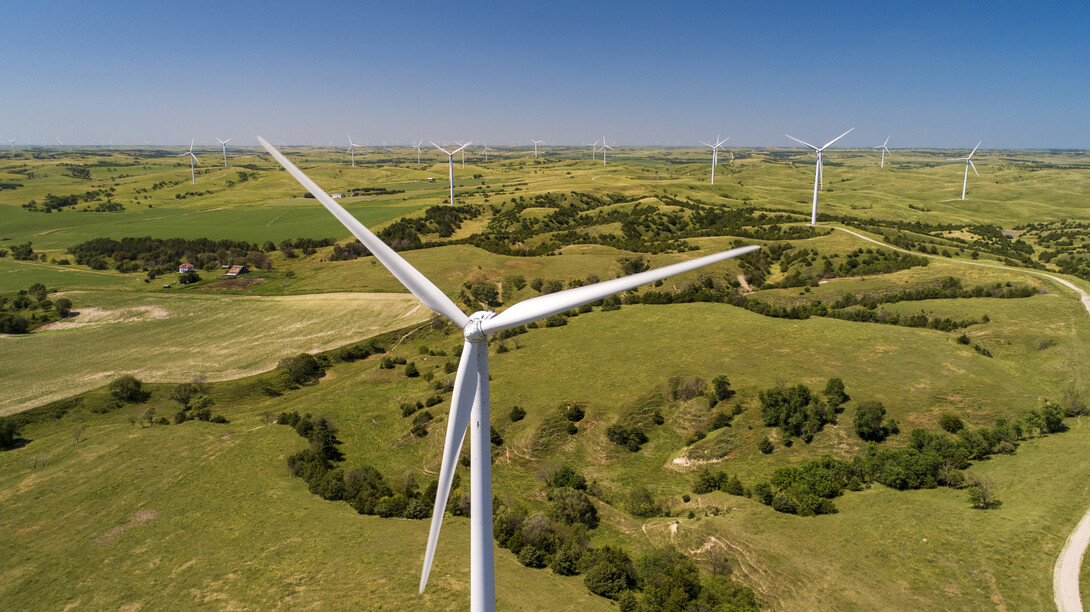
Rural Nebraskans are more supportive of home- or community-based wind and solar production than large-scale production models, and more supportive overall of solar energy production versus wind, according to the 2025 Nebraska Rural Poll.
Fifty-six percent of rural Nebraskans surveyed support home-based systems for solar energy production, such as solar panels installed on private property and owned by the landowner. Fifty-one percent also support community-based production, which often works as cooperative models. In both cases, excess energy can often be sold to local power companies. But support for either home- or community-based wind production systems is mixed, with about equal preference for or against.
When it comes to large-scale operations, however, most respondents strongly or somewhat oppose large-scale energy production through wind (59%) and solar (52%). These operations are generally private companies that install wind turbines or solar panels on land leased from local landowners, and they supply electricity to an entire region.
“Rural Nebraskans’ preferences show a clear desire to keep energy production local,” said Heather Akin, assistant professor in the Department of Agricultural Leadership, Education and Communication. “People are open to renewable energy, especially when it’s owned and operated close to home, where the benefits stay in the community. The hesitancy toward large-scale projects suggests that rural residents want to be sure those projects really serve local interests.”
Some regional differences exist when examining the support for these various energy production scenarios. Respondents in the north-central region tended to be least supportive of any of the scenarios, while those in the Panhandle were most likely to support each of the farm- or community-based systems.
When asked about positive and negative impacts of wind turbines, the poll found 53% of respondents believe they can create visual or aesthetic problems. Many respondents also agree that wind turbines cause other problems, such as harming birds and bats (48%) and creating noise pollution (46%). But many also agree they have positive impacts on job creation and economic benefits for local communities (45%).
Opinions are divided on whether wind turbines can help keep land in agriculture. Forty-two percent of rural Nebraskans surveyed are uncertain about that statement, while 33% disagree and just 24% agree.
“We see varying opinions about the impacts of wind turbines, which is likely contributing to the lower support for those energy production systems,” said Cheryl Burkhart-Kriesel, a Rural Prosperity Nebraska extension specialist based in the Panhandle. “Other than a general agreement that they’re aesthetically displeasing, these mixed opinions from region to region suggest that if wind energy is going to become more prevalent across the entire state, communities will need to start having open conversations about local priorities, land use and economic impact.”
Not many rural Nebraskans surveyed have direct experience with wind and solar energy production. Just 13% can see wind turbines from their home, or land they own or farm. Five percent own or lease solar panels. Only 3% can hear wind turbines from their home, or land they own or farm.
When considering whether to locate small wind turbines on their own land, to power a home, farm or ranch, most respondents rate factors such as the reliability of turbines or panels, the cost to install them, having backup power during outages, energy savings and fit in the landscape as very important:
- Reliability of turbines and/or panels (80%);
- Availability of a trusted installation and maintenance company (77%);
- Financial support to offset installation cost (72%);
- Provided power during main grid outages (70%);
- Amount of energy savings or income that turbines and/or panels would provide (63%);
- Turbines or panels fit in the local landscape (60%).
Thirty-three percent of respondents rate that turbines or panels would show their commitment to sustainability as very important.
“For most rural Nebraskans, renewable energy is still more of an idea than a personal experience,” said Becky Vogt, manager of the Rural Poll. “People are more interested in the practical benefits — reliability, cost savings, trusted service — than in symbolic or environmental reasons alone. As more residents see these technologies in action, confidence in their value within rural communities may continue to grow. That’s to be seen.”
To read the full report, “Rural Nebraskans’ Perspectives on Energy Resources,” visit the Rural Poll website.
The 2025 Nebraska Rural Poll marks the 30th year of tracking rural Nebraskans’ perceptions about policy and quality of life, making it the largest and longest-running poll of its kind. Last summer, questionnaires were mailed to more than 6,700 Nebraska households, with 943 households from 86 of the state’s 93 counties responding. The poll carries a margin of error of plus-or-minus 3%. Conducted by Rural Prosperity Nebraska with funding from Nebraska Extension, the Rural Poll provides three decades of data on the voices of rural Nebraskans. Current and past reports are available here.
Share
News Release Contact(s)
Related Links
Tags
High Resolution Photos
HIGH RESOLUTION PHOTOS